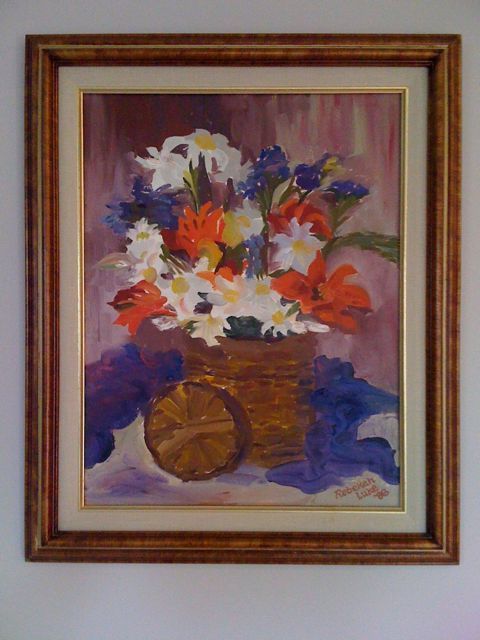
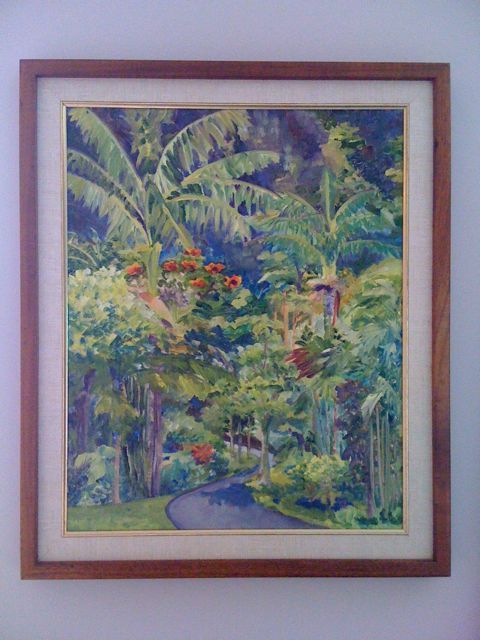
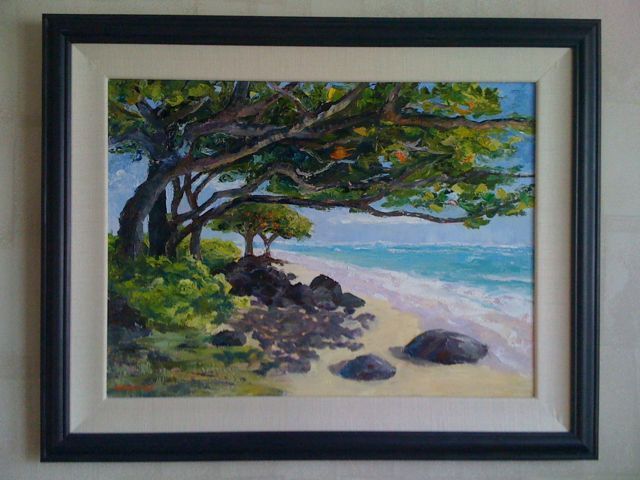
My post “Hello from Pennsylvania” is lost in transit. In the meantime I will show you three of my oils that live at my sister-in-law Penny’s house in Pennsylvania.
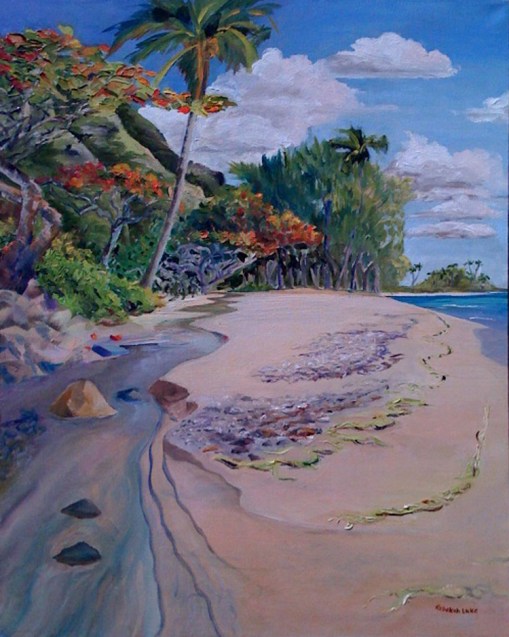
I painted the basket of flowers as a student of Gloria Foss. The green one is a scene at Hoomaluhia Botanical Garden on Oahu. The seasscape is of Kaaawa beach; Penny commissioned this painting of the place where her children played when they visited us in Hawaii.
I’m always delightfully surprised to see my work hanging in people’s homes and how they have been integrated as decor. These show the images in their picture frames, Penny, thanks for everything. The paintings look great! ~ Rebekah
Paintings at my sister-in-law’s
12 12 2009Comments : 2 Comments »
Tags: Hawaii, oil painting
Categories : Fine Art
View of the Koolau Range and the sea
23 11 2009
Another view of the gorgeous mountains of the Koolau Range on Oahu is off my easel and waiting for its protective varnish coat and frame. I’m so thrilled that it’s finished, I want to show it to you.
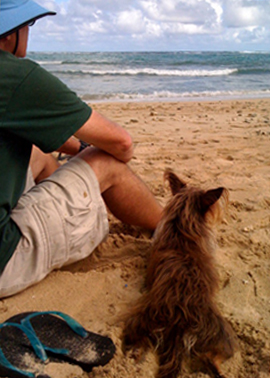
On Sunday we found some time to relax. Here’s a familiar scene of repose at the beach: DH and Alice Brown by the sea.
Copyright 2009 Rebekah Luke
Comments : Leave a Comment »
Tags: beach, Fine Art, Hawaiian, Koolau Mountains, Koolau Range, Oahu, oil painting, seaside
Categories : About me, Fine Art, Friends & Family, Hawaiian
Makahiki, yule and gift giving
9 11 2009With the winter holiday season upon us, most families are starting to get into the spirit. The signs include that real or imagined cold snap on Halloween night, slick merchandising catalogs overflowing from our mailboxes, store mark downs everywhere, and the lure of local craft fairs and festive events.
Conversations now include, “What are you doing for (fill in the holiday)?” and newspaper features carry tips on how to remain stress free. We want to remember family and friends and hope no one is left alone. As families extend generationally, geographically, and by marriage, there can be many decisions to make.
DH and I have a couple of philosophic ideas and old-fashioned traditions that give us a sense of peace. They link to our respective roots—Hawaiian Islands for me and Pennsylvania (Delaware County) for him.
One is to acknowledge and be mindful of the Hawaiian Makahiki season, roughly from mid-November through January (exact dates depend on the moon). The planting season is over, work is pau (finished), and warring ceases. It is the time of the god Lono.
The best of the harvest is dedicated to Lono in the form of ho‘okupu (offerings). The people give thanks, relax, socialize, play outdoor games, and generally enjoy themselves. No stress. It’s officially okay to play!
The other is adopted from Winterthur, Delaware, not far from DH’s birthplace. As tourists we visited Winterthur, a museum and the former country estate of Henry Francis du Pont. During his life H. F. du Pont collected whole room interiors of various periods, not to mention whole street fronts, and installed them in his mansion.
The museum decorates the rooms of this big house for Yuletide, and visitors can tour them around the same months of Makahiki in Hawaii. The holiday decor matches the period style of each different room. It’s educational and very festive.
When we visited, our favorite room showed how du Pont’s own family celebrated in the first half of the 20th century. The story was told that Yuletide, the time around the Winter solstice, was a time to visit and entertain friends, to rest and to celebrate a successful harvest. Children were seen but not heard.
Decorations consisted of a small table-top evergreen—adorned simply with cookies, candles and strands of popcorn and cranberries—that was set atop a pie crust table. Gifts were exchanged among immediate family members only and placed in a basket for each person. If the children behaved well, they could have the cookies!
We liked the idea so well that we brought home a furniture piece similar to a pie crust table for ourselves, in a nod to the East Coast style and DH’s regional heritage. Each year we hang on a small tree the wooden ornaments crafted by DH’s parents for their first granddaughter on her first Christmas.
At a lost for that special gift?
FOR YULE or any other special occasion such as a wedding, a big birthday, an anniversary, or a move to a new home, do consider giving a painting. Yes, a painting! An original oil painting is special and unique, so unexpected, so memorable. It is a one-of-a-kind piece of art, it’s durable, and it can provide years of long-lasting enjoyment. Support the Native Hawaiian artist! I can work with you now on a selection and a payment plan, if necessary. I will be traveling and away from the studio for a good part of December, so if you are at all interested, please contact me. Click on PAINTINGS in the menu bar to see the images. I’ll be installing additional pieces in the next few days too. Thank you!
Copyright 2009 Rebekah Luke
References:
In years past I have participated in the Makahiki observance on Kahoolawe island. You may read about Makahiki on the Protect Kahoolawe Ohana website:
http://www.kahoolawe.org/home/?page_id=7
For more about Winterthur and the du Ponts, click on this link:
Comments : Leave a Comment »
Tags: art gift, Christmas, holiday, holiday tradition, Kahoolawe, Lono, Makahiki, special occasion, winter, winter solstice, Winterthur, yule
Categories : About me, Fine Art, Friends & Family, Hawaiian
Vog: an art lesson
29 10 2009It’s voggy in the landscape today. I saw it when I drove from Kaaawa to Kaneohe.

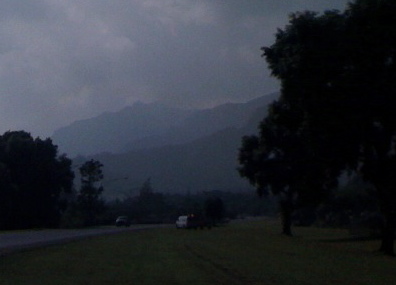
The Koolau Mountains in vog, about 10:15 a.m. today. Notice the ridges appear in three tints of gray.
What’s vog? Vog is the less-than-clear air that we have when the kona winds from the southeast blow the emissions from the volcano up the island chain toward the northwest. It’s like the words fog and smog. It hangs around until the regular trade winds return.
Vog is worst on Hawaii island, a.k.a the Big Island, home of the eruption. The falling ash deteriorates homes and crops, and the smokey air makes it hard to breathe. It reminds me of when I arrived at art school in Pasadena (Los Angeles) one August and was told as I gazed out the floor-to-ceiling windows, “The mountains are right there in our backyard, and they’re beautiful, but it’s so smoggy, we can’t see them.”
One good thing about the atmosphere as today’s vog, though, is that it serves to explain how to paint distance. Generally, objects in the foreground have the darkest value, and as objects recede into the middle-ground and background, they become lighter in value. As one’s eye moves back into space, the values become lighter.
On an ordinary sunny day, the kind that prompts us to say, “It’s just another beautiful day in Hawaii!” the Koolau Mountains are clear and colorful enough to see the individual trees on them. To represent such a scene with paint and for it to “read” properly, we consider the logic of light and either lighten and/or mute the colors in the background, even though we don’t see them that way with our eyes. But on a day like today, you absolutely can see it.
If you have ever seen the Blue Ridge Mountains in Appalachia, or photos of them, it’s the same thing.

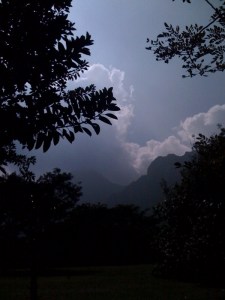
Nuuanu Pali Lookout (center of photo) viewed from Luluku, about 10:30 a.m. today
This morning my destination was Hoomaluhia Botanical Garden at Luluku at the foot of the mountains where I go to paint. Here is a photo of the Nuuanu Pali pass viewed from Luluku. Ordinarily the cars on the highway and the people at the lookout are visible.
Notice that both photos appear blue, or blue-gray. My own eyes did not see the scene this way because I am used to seeing the scene in full color (the whole spectrum), and my brain translated it into full color. But, as the saying goes, the camera doesn’t lie. Blue is the color of atmosphere.
Now, knowing about values (shades of gray) as they relate to distance, and knowing about the color of atmosphere, you can represent distance in a painting by muting and lightening the colors of objects as they recede.
If you forget to do this initially in an oil painting, there is a glazing technique you can use, but only after the paint is dry. Take a dollop of painting medium with your palette knife and mix it with a tint of blue pigment (e.g., white + ultramarine + cobalt). Have a clean, soft cloth handy. Brush the glaze over the part of the painting that you want to lighten. Then, working quickly (because glaze dries fast), wipe off with the cloth little by little, if you wish, to get the effect you want. Ta-dah!
The values underneath that you painted originally will stay the same, that is, the relationships among the values will remain. You are simply putting in the atmosphere with your tinted glaze.
Don’t worry if the glaze gets beyond the area you want. Just go back and paint over it. (We call that “destroy and recover.”)
Copyright 2009 Rebekah Luke
Thanks to Gloria Foss who taught me how to do this. To see my oils, click on PAINTINGS in the menu bar.
Comments : 2 Comments »
Tags: art, art lesson, Big Island, Hawaii, Koolau Mountains, oil painting, painting, vog, volcano
Categories : Fine Art, Hawaiian, Travel
Why write? why paint? why heal?
15 10 2009Rebekah’s Studio features old-fashioned letters, paintings and healing. Why write? Why paint? Why heal?
In the current 42-day world gratitude experiment shepherded by Stacey Robyn, the meditation for Day 27 is “Writes of Passage.” The suggestion is to ponder, “Who am I grateful for?” and write a letter to thank this person without the pressure that it needs to be delivered (because it doesn’t).
Stacey Robyn notes that psychology professor Peterson of the University of Michigan gives students a homework assignment now and then of writing such a gratitude letter, a belated thank you note, if you will. The letter writing “provides long-lasting mood boosts to the writers.” The professor says his students feel happier one hundred percent of the time.
Lately I have been trying to locate a certain Alan who was a fan of my oil paintings when I first started exhibiting my work. He would see the announcements in the paper and show up at the openings. Passing by one day he saw me painting on location at Kaaawa Stream and pulled up along the side of the highway. He cheerfully called out the window, “Let me know when you’re finished with that one, I’d like to see it.”

The painting he admired
As it turns out, this was quite some years ago, and after a long pause in painting I pulled out the canvas just this spring and completed it. I remembered Alan and set out to contact him. It’s a wonder to me how I remembered his name—his first name, and then after a couple of days, his last name. No luck in the printed phone directory, and initially nothing familiar in various searches on the internet.
My research brought me to a blurb and photo from Hawaii Fishing News, reporting and depicting a fisherman with the same last name and looks who had caught a 100-plus-pound ulua fish in the summer of 1999 and who thanked Alan for his help. Being tenacious in my research, I contacted HFN who kindly gave me the fisherman’s phone number. I left call back messages twice, but no one rang back.
Still wanting to reach Alan, I took to searching the internet again. Last night I came across an esoteric article by T. Castanha, “Aia Na Ha’ina I Loko o Kakou (The Answers Lie Within Us),” concerning the “Boricua Migration to Hawai‘i and Meaning of Caribbean Indigenous Resistance, Survival and Presence on the Island of Boriken (Puerto Rico).”
The article is interesting to me for its insight on the situation of the indigenous peoples of Boriken and the Hawaiian Islands both. The paper was presented in Hilo at the 1999 World Indigenous Peoples’ Conference on Education.
More intriguing to me was that the author dedicated his presentation to his friend, brother and roommate, who recently passed on, the article stated, his friend who had the same name of the Alan I was looking for.
There, then, was the answer for me.
And here, now, is my gratitude letter to a faithful fan: Mahalo, Alan, for encouraging my art. Perhaps our paths will cross again.
Copyright 2009 Rebekah Luke
In a Reiki healing session, we thank our Reiki masters in spirit from the heart. Like writing a gratitude letter, Reiki can help one feel happier. For more information, click on Reiki Healing by Oelen in the menu bar.
Comments : 4 Comments »
Tags: art, gratitude, Hawaiian, indigenous people, oil painting, painting, Reiki, thank you note, thankfulness, world gratitude
Categories : About me, Fine Art, Reiki Healing
Avos and cocos
11 10 2009two coconut palms. As long as the tree avocado grows and grows birds will have a home.

Avocado Pear
I offer a haiku and a painting to honor and thank the avocado tree.
This year it produced 15-20 fruit, judging by the number of sprouting seeds on the kitchen counter. That’s a bumper crop. Usually we gather just six, but each weighs three pounds. They’re super good, and I try to reserve a couple for the previous homeowner, Linda, who was a good steward of the aina (land) and planted the tree.
The season is over, and we’re enjoying the last of the fresh guacamole.
If you would like a little avocado tree from ours to plant in your garden, and you live in Hawaii, let me know.
Copyright 2009 Rebekah Luke
“Avos and Cocos” is from my book From My Window Seat: Views and Song. —RL
Comments : 1 Comment »
Tags: abundance, avocado, avocado pear, celebration, Fine Art, gratitude, haiku, oil painting, Poem
Categories : Fine Art, Poem
Wrongful occupation of Hawaii
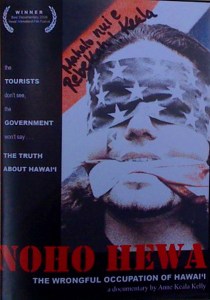
9 10 2009Anne Keala Kelly has made a very disturbing documentary film entitled “Noho Hewa: The Wrongful Occupation of Hawai‘i” that all Hawaiians and Hawaiians at heart should see. It is so disturbing that at the end of last night’s screening, when the house lights came up and Keala asked the audience for questions, there was dead silence in the Paliku Theatre of Windward Community College.
“Noho Hewa: The Wrongful Occupation of Hawai‘i” is so disturbing that it won the Best Documentary 2008 Award of the Hawaii International Film Festival. That was last October. Now, ten more minutes have been added, and the DVD is now available for $20 to help the filmmaker recoup her expenses.
Our family bought two copies. You may go to nohohewa.com for information about future screenings or to purchase the DVD. Keala will take her guerrilla film to the University of New Mexico in Albuquerque on October 12, 2009, and to Pacific Lutheran University in Tacoma on October 15, 2009. Admission is free.

For more information by the filmmaker, visit nohohewa.com
Quoting the DVD cover notes of “Noho Hewa”:
Hawai‘i, thought of by most as the 50th state, is, according to international law, an independent country under an illegal and prolonged occupation by the United States. Through this occupation, Hawai‘i has become home to the largest military command on earth. It also has more endangered species’ habitats per square mile and is the location of more open field tests of genetically modified organisms than anywhere else in the world.
Beyond the illegitimacy of the U.S. presence in Hawai‘i, “Noho Hewa” looks at the methodical removal of Hawaiians from their homeland. The film considers how the erasure of Hawaiian people and history through government sponsored acts of desecration is central to an ongoing agenda to ethnically cleanse Hawai‘i of the Kanaka ‘Oiwi, the indigenous population of Hawai‘i.
If you are alive at all, “Noho Hewa” will shock you. I am Hawaiian. I consider myself an activist. My Hawaiian friends, neighbors, citizens of Ka Lahui Hawaii, and my extended family are in this film. This piece of journalism—it’s excellent—has woken me up even more to the truth about Hawaii, my beloved home. If you can, share this information with others and decide what you will do. It will take all the courage you have. Mahalo to Anne Keala Kelly for hers.
Copyright 2009 Rebekah Luke
Comments : 2 Comments »
Tags: Anne Keala Kelly, Hawaii, Hawaiian, Hawaiian sovereignty, indigenous people, Noho Hewa, United States military, US military occupation
Categories : Fine Art, Friends & Family, Hawaiian, Travel


Recent comments