Foods my ancestors ate

20 05 2011

Hakka menu

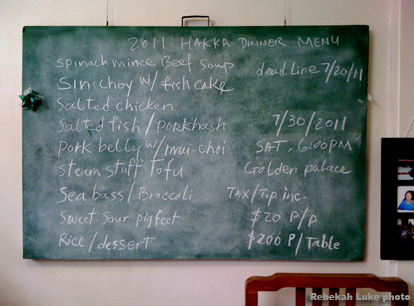
The theory of eating the foods my ancestors ate for good health came to mind when I saw two board menus recently: a Hakka dinner menu planned by the Tsung Tsin Association in Honolulu, and the day’s local specials at the Heeia Pier General Store and Deli on Oahu.

They reminded me of a model for sustainability presented at the “Chefs & Farmers Facing Future” forum I attended last month: create tighter communities and make friends with your neighbors.

At lunch with Cousin Millie (see my 5/15/2011 post) she asked if we would be interested in joining the Tsung Tsin Association, an international club that practices and preserves the (Chinese) Hakka culture.
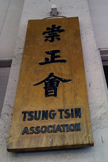
We have Hakka genes. Hakka people descend from the Han people and migrated at various times for various reasons from northern China to the south and beyond. Hakka people are still migrating. They are nomadic.

Cousin Audrey Helen and I decided we would go to the Sunday meeting in Chinatown (Millie couldn’t make it) to check it out—for Millie—and report back. What do they do? I asked. Millie said she was told they eat and learn about Hakka culture (in that order). I chuckled.

Everyone the world around agrees eating has priority. There it was on Sunday—a Hakka Dinner Menu posted in the clubhouse. There are no Hakka restaurants on Oahu, but the association found a restaurant in Chinatown that would cook the special menu for them. I thought of my friend Linda.

I met Linda in the Sunset magazine food test kitchens in the Seventies. I left the magazine after a couple of years, and she enjoyed a long career as food editor. When she retired in 2005 Linda planned a trip to China to research Hakka cuisine. It was an eating tour with all the arrangements made, right down to the chef of most meals, by Linda. She needed two more travelers to make up her party of 10 for a group rate, so DH and I did not have to think twice to accept the invitation. All we had to do was pay and show up in Beijing on the appointed day.

There are some basics to Hakka cuisine, but we also found that food took on added flavors from whichever region Hakka people lived.

Both Linda and I will have food books out in 2012—hers the product of her Hakka cuisine research, and mine a reprint of Everyone, Eat Slowly that has recipes and anecdotes of my family. The Tsung Tsin Association members might want copies, I’m guessing.

So that’s the Chinese side.

The other side is part Native Hawaiian. What’s native on the menu below is the “kalua pig,” “guava,” “kalo” and  “o‘io.” And it wasn’t lost on me! These foods are not the traditional plate lunch fare. How refreshing to see what the new chefs like Mark Noguchi are coming up with.
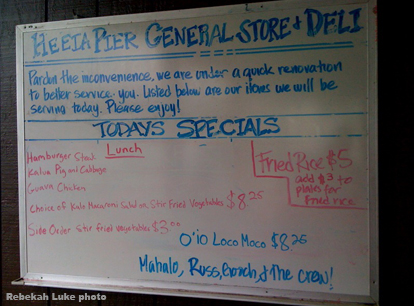
Looks good to me

The eatery that served up local-style food at the end of He‘eia pier, has reopened under new ownership/management, much to my delight. It had been closed for months since the previous owners retired. It is one of the very few ocean-front restaurants on the long coast between Kailua and Haleiwa. DH and I used to bicycle there from the studio for breakfast and watch the fishing boats come and go, or stop there on the drive back from town. Its scenic value is popular with artists.

From this menu, though the other diners recommended the guava chicken, I tried the fried rice. It’s a sautéed mixture of onion, green onion, carrot, egg, bacon, Spam—all diced finely—rice, and (I think) a little oyster sauce.
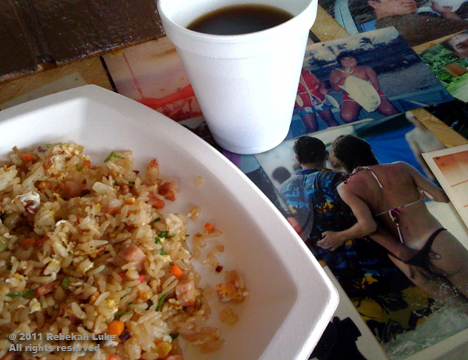
Island fried-rice breakfast at the counter decorated with snapshots. Wow!

You can sit at the picnic tables or the small counter and listen to the folks talk story, or meander down the dock and watch the people fish for their own food. A man offered me some dried aku he made to go with my fried rice.
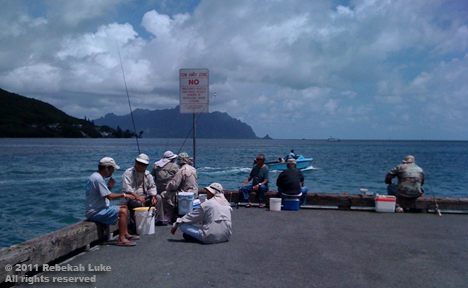
He‘eia pier

All this seems to fit in nicely with the message received from the “Chefs & Farmers Facing Future” food forum, organized by shegrowsfood.com and Leeward Community College, whose food service students wanted to give back to the industry that gives so much to them. The event brought together farmers, fishers, aquaculturists, ranchers, chefs, and media reps to explore promoting and using locally produced food for sustainability in our island communities.

The meeting started with the sobering fact that there is only about a 10-days’ supply of food here with most of it arriving by ship or plane.

What I took away from the meeting was the notion that to sustain we should form tighter communities and make new friends with our neighbors within them.

As the Hakka association that takes care of its clan. (My grandmother took care of her own family of 15 and neighbor bachelors by growing vegetables in her victory garden.)

Or the young creative chefs serving dishes with local ingredients, or the man who gave his fish to me, or my own developing garden that sometimes produces enough to share with the neighbors. It’s a great life.
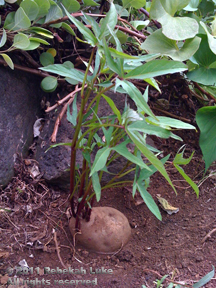
Sweet potato in my garden
Copyright 2011 Rebekah Luke


Three sisters in Shanghai: is one my mom?

13 09 2010

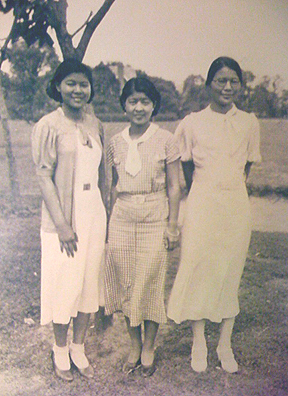
Shanghai, June 9, 1935: Maybe my mother, Aunty Inez, and Aunty Yun

Hello Family (Mom’s side),

While reorganizing and recycling things from the studio, I came across this photo. The handwritten caption reads, “The 3 sisters — who is the tallest? My pumps didn’t help to make me the tallest. Ha! Ha! June 9, 1935.”

Beloved Aunty Yun is at the far right, Aunty Inez is in the middle, and at first glance I identified the sister on the left as my mother, age 18. But looking again, is it she? Maybe, maybe not.

In the 1930s after my grandfather Chong How Kong died, my grandmother Siu Chin and many of her 14 children and their young families went to China from Hawaii, mostly as tourists. Some taught at the university level or worked. With my Uncle Fan’s and Aunty Yun’s tuition and room & board support, my mother went to the University of Shanghai to study music, English, and education.

They were all there until World War II broke out in China, and they made their way back to the Islands. Otherwise they may have stayed in China, and probably I would not be here. Mom continued her college education at the American Conservatory of Music in Chicago, returning to Honolulu to teach and direct music when she finished.

My mother was a member of the Mid-Pacific Institute Class of ’34. According to J. H. Kim On Chong-Gossard’s writing, our family genealogist, she traveled alone to Shanghai in September 1935. If she is in the photo, then one of the dates is wrong.

I emailed the photo to Cousin Millie, asking what she thought: Fo-Tsin (my mother) or Lois (Millie’s mother)? For Lois was in Shanghai too. Of course neither I nor Millie was born yet. I just haven’t seen a picture of my mom that full of face, but perhaps at 18 she was heavier than I’m used to seeing her in other photos. I usually recognize her high angular cheek bones. Photographers loved using her as a model.

While waiting for Millie’s opinion, I went through mom’s letters, photos, and other papers I still can’t throw away, even though I have no real heirs to save them for. I guess I’ve saved them for me, for a day like today.

I found one of her report cards from the University of Shanghai dated February 19, 1935. Another records that she entered the U. of Shanghai in Spring 1935.

I also found a letter she wrote to Aunty Nyuk in California, dated January 12, 1934, from Peiping [now Beijing]. Aunty Nyuk kept all of the correspondence, and after she died, the letters found their way to me. With all of my 14 aunties and uncles and their spouses now passed, it’s like piecing together a puzzle to get a fuller picture.

Some things are nice to keep. Unless Cousin Millie thinks that’s Lois on the left, I’ll gladly say, that’s my mom and my aunties!

Copyright 2010 Rebekah Luke

Epilogue: Millie says not her mom.


Stories as legacy

27 03 2010

Stories can be legacies. I was reminded of this when my cousin Galien sent me the Hawaii island press photos and story of Kalahikiola church with a note, “It shows you how Kohala takes care of its own, rarely waiting for the government or others to do their needs.”

The photos show the congregation seated in pews of a renovated interior. The news article reports that on February 27, 2010, while most of Hawaii waited for a potentially damaging tsunami from an earthquake in Chile, the people of North Kohala were in church to dedicate their newly rebuilt Kalahikiola church building, a casualty of an earlier natural disaster: The earthquake on October 15, 2006, off the coast of the Big Island of Hawaii caused the stone walls of the church, located at Kapaau, to crumble.  A dramatic photo showed the damage to the world.

Among the relatives of my mother’s side of the family, what we noticed in the 2006 photo was that the bell tower was intact. (Click on “dramatic photo” in the above paragraph.) Growing up, we were told the story of how our grandfather — who managed the grounds of Dr. Benjamin D. Bond’s estate that included the church — repaired the bell tower in the early 1900s, replacing rotted timbers one by one.

Yet, actually, someone read and quoted the anecdote in Father Bond of Kohala: A Chronicle of Pioneer Life in Hawai‘i by Ethel M. Damon (Honolulu: The Friend, 1927) about “Ah Nee, the faithful Chinese workman,” the only carpenter who dared to undertake the repair. (He was called Ah Nee, which means Two for the second son, but his correct name was Chong How Kong.) And that quote is re-cited in our cousin J. H. Kim On Chong-Gossard’s The Chong Family History (Kaaawa: Chong Hee Books, 1992).

Our grandfather died in 1930, but when we saw the 2006 photo of the church with the untouched bell tower, we patted him on the back anyway. We cherish this connection to Kohala. It’s the story we pass down, even though there are so many more stories, given that my mother and her 14 siblings were born and began their lives there. But that’s the story we know about our grandfather.

Accuracy is part of my training and experience. My 6th grade teacher taught how to use a dictionary, how to outline, and drilled us on “speed and accuracy.” When writing the daily news, it’s customary to check facts with more than one source; two to concur, but three are better. In the Sunset test kitchen we made a recipe a minimum of three times before publication.

Recently I became involved for five years in designing and managing the publication of bi-lingual children’s story books in Hawaiian and English for a non-profit educational organization in our area. The stories were to ring true to the Hawaiian culture, places, customs, heritage, etc.

The storybook project was by the indigenous community and involved many partners, writers, reviewers, elders, editors, photographers, designers, and translators. While allowing an author’s voice, I lobbied my darndest to avoid what I felt were inaccuracies, but sometimes I wasn’t successful.  In the end I relaxed and said okay to some things that I’d now regard as modern myth.

This past week the publisher, Na Kamalei – K.E.E.P., released its Hawaiian-culture-based early childhood education curriculum for families. It’s wonderful, and it integrates 20 of the story books into the lesson plans. It is for use by family and child interaction learning programs.

I still feel accuracy is important, so as not to perpetuate something that’s not so, thereby creating a myth.

What stories do you remember? What stories will you write or tell? What legacy will you leave?

Copyright 2010 Rebekah Luke


What is family, island style

13 09 2009

Today might be a good day to talk about my family, or shall I say families. I’ll at least start. I am an only child, and my bloodline ends with me. Sometimes people feel sorry for me because of that, until they discover, “Oh, you have Family!”

Today might be good day to talk about family because we’re having Sunday dinner with my hanai family at our house, and I’m cooking. It’s our turn, and it will be a coming out party for 4-month-old Ayla (see my post “Miss Marvelous discovers her toes”), who is the daughter of my step-daughter.

My hanai (adopted) family came into my life about the time I transitioned from high school to college, well, earlier when I met Margy the first day I was a 9th grader. We remained best friends through Punahou. During my parents’ divorce when I was 17, Margy’s  parents—a doctor and his wife with six children—welcomed me into their home where I roomed until I landed my first job at The Honolulu Advertiser as a general assignment reporter. With that job I earned enough money to pay for my own apartment on Lanihuli Drive and moved out.

Family dinner is usually at Mom’s house. This is typical everywhere, as long as the matriarch is living, isn’t it? After that, the family sort of breaks up and the next generation of matriarchs takes over.

We’ll see who shows up: My nephew might have a flag football game. I’m told he is one of the better players. His dad who followed his father’s footsteps and became a physician—stay with me, now—might be on call. My sister, who competes in dressage, is showing her horse for the first time in a two-day event this weekend and hopes she will have the energy afterward to drive out to Kaaawa from Waimanalo. And ditto about the energy for a brother and his family who have a lunch party to attend at Bellows beach.

Some of my hanai family in the summer of 2008 in Washington, D. C., the year our mom Ivalee received the Jefferson Award.

Mom, who doesn’t drive anymore, will be catching a ride with Becky. Becky and I were each others’ first roommates in the Lanihuli apartment, and she’s family too. In any case, I’m making food for 15. Everyone wants to see and meet the baby.

Today might be a good day to talk about family because on Reiki Friday I saw a client from glee club who read my post “Sweet memories and coming home, part 1” and asked if I was related to Uncle Harry and Aunty Edna.

It is a growing fashion these days where I live to address anyone older than you, if even by a couple of years, as Uncle and Aunty whether you are related by blood or not. I’m sure it is done out of respect, but some people use the names almost as if they are punctuation marks in a way that, in my opinion, dilutes the title. I tend to agree with an authority on Hawaiian naming at Kamehameha Schools who prefers not to be called Uncle unless he is your real uncle. That’s okay, you can call me Aunty, but I prefer Aunty Rebekah.

So when my client asked if I was related to Uncle Harry and Aunty Edna, I thought to myself, yes, that’s why they are Uncle and Aunty, but I understood why she asked. Then I saw her resemblance to Harry. It turns out that Harry and Edna were her uncle and aunty too, and we’re related!—by marriage.

“We used to drive to Wahiawa to get lychee every year,” she said.  As they say, small world. Through family ties that extend all the way back to Kohala and the Basel Mission in China’s Kwangtung province, she explained how she knew many of my first cousins on my mother’s side of the family. My mother was the youngest of 15 Chongs. But that is another story, a story told in The Chong Family History by J. H. Kim On Chong-Gossard.* I sent my client off with a copy. “You’ll enjoy this because you know all of the people in it,” I said.

We are One.

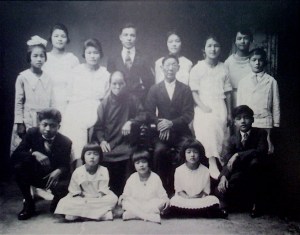
My maternal grandparents and 13 of their 15 children in Kohala. My mother, seated front row and center, ws the baby of the family.

These are my ancestors: my maternal grandparents and 13 of their 15 children in Kohala in 1920. My mother, seated front row and center, was three years old and the baby of the family. Edna is the tall, darker complected girl on the right in the back row.

Copyright 2009 Rebekah Luke

* The Chong Family History by J. H. Kim On Chong-Gossard (Kaaawa: Chong Hee Books, 1992, ISBN 0-9634186-0-2, soft cover, 172 pages) is a five-generation family biography, or Jia Pu, of Chong How Kong and Pan Siu Chin and their descendants. Copies sell for $35 and are available from the publisher Chong Hee Books, P. O. Box 574, Kaaawa, HI 96730.

For information on Reiki Friday, click REIKI HEALING BY OELEN in the menu bar.